










One no deposit bonus can exist as several documents. An operator serving players across many markets publishes its conditions in more than one language, and the wording shifts between those versions while the figures underneath are supposed to stay put. Scale is why: the EGBA counted 43.8 million active customer accounts across its members during 2025, a rise of 13 percent, spread over markets with little in common linguistically. A multiplier is a multiplier in any language, though, and so is a spin count, a ceiling and a promotional code. Grouping the ten below turns on one question: do the conditions cap an individual round throughout the bonus? Three say yes, seven say nothing, and that clause is among the easiest to skim past in whichever version a reader opens.
What stays constant
- Figures are the portion of a set of terms that does not move with the language: multipliers, spin counts, ceilings and codes read the same in every version.
- Wagering: 3x where it is lightest, 50x where it is heaviest.
- Three offers pin an individual round at 5 Euro throughout the bonus.
- Published ceilings run between 10 Euro and 100 Euro.
- Where a site publishes in several languages, one version is stated as the governing one, and EGBA members took 18 billion Euro in online gross gaming revenue during 2025, up 34 percent, across exactly that kind of multi-market operation.
Ten no deposit bonus offers, split by the round cap
Whether a requirement clears fast or has to be ground out depends largely on one clause: the cap on round size. Three offers below publish one, at 5 Euro, and they come first. Seven publish no cap, leaving multiplier and ceiling as their only stated constraints. Inside each group the lightest wagering comes first. Everything below comes off the operators’ own conditions; silence there means silence here. Each entry is numbered, which matches it to the table set out further down.
1. Jet4Bet, a capped round and a 40x requirement
- Round cap for the bonus’s duration: 5 Euro
- Spins: 50, landing on the Aloha King Elvis reels from BGaming
- Ceiling: 100 Euro
- Wagering: 40x, measured on winnings
- Code: BONUS50
- Stake a round: unpublished, leaving the package unpriced
Notice that cap, which operates unlike any clause beside it. Multipliers are targets. Ceilings bound what exits an account. A cap does neither job: breach it once and the balance departs, carrying off accumulated turnover with it. Every round falls under it until the requirement closes.

2. Boho Casino, thirty rounds under the same cap
Thirty free spins here, on BGaming’s Fruit Million, FMIL30 going in during registration. Requirement: 40x against winnings. Round cap: 5 Euro. Ceiling: 100 Euro. Every figure duplicates entry 1 bar the reels and the count. The count tells, too. Thirty is the briefest allocation anywhere here, and a short run yields fewer openings for assembling the balance a multiplier then works on. No stake per round is published, leaving the package unpriced. Fruit Million works a plain fruit-symbol grid, the steadier of this group’s two reel sets.

3. Slots Gallery, the third brand on these figures
How far do these three coincide? Completely, on everything the conditions quantify. Another thirty, this time across Wild West Trueways from BGaming, claimed on 30WW, beneath 40x with a 5 Euro round cap and a 100 Euro ceiling. Entries 1 and 2 publish those same three numbers. What varies is the reels, plus the allocation at entry 1.
Does identical wording mean one offer? No. Registration conditions belong to each brand separately, and no relationship between the three sites is published anywhere.

4. V.Vegas, a 3x requirement
| Item | Detail |
|---|---|
| Maximum stake | None published |
| Spins granted | 50 |
| Spin value | 0.20 Euro, for a 10 Euro package |
| Wagering | 3x |
| Payout ceiling | 25 Euro |
| Assigned title | Book of Dead (Play’n GO) |
| Code | None published |
As light as this page goes is triple the winnings, and the second group begins there. Nothing is keyed in: credit follows an accepted registration. A requirement that slight hands control of the outcome to the 25 Euro ceiling instead of the staking, inverting how the two figures usually relate.

5. HitNSpin, fifty-five rounds at 0.10 Euro
The requirement matches the entry above at 3x, and the allocation is the biggest among offers quoting a stake: 55 rounds of 0.10 Euro, worth 5.50 Euro together. No code applies.
What separates the two is the ceiling. At 10 Euro this is the tightest on the whole page, under half what V.Vegas allows and well below what the 40x offers permit. Reels come from Reel Kingdom: Big Bass Splash, one of the studio’s long-running fishing titles.

6. Slotoro, a ceiling scaled to the win
Conditions, in order: 50 free spins; Gates of Olympus from Pragmatic Play receiving them; 0.20 Euro a round, which prices the package at 10 Euro; 5x on winnings; no code at all, credit arriving with registration; and a ceiling framed as three times the rounds’ own output rather than as any fixed sum. No other entry is built along those lines. Win 44 Euro and the payout holds at 132 Euro; win less and it holds proportionately lower. The limit tracks the outcome in place of lopping it off. At this stake level the volatile build is Gates of Olympus, dropping multiplier symbols into a tumbling grid.

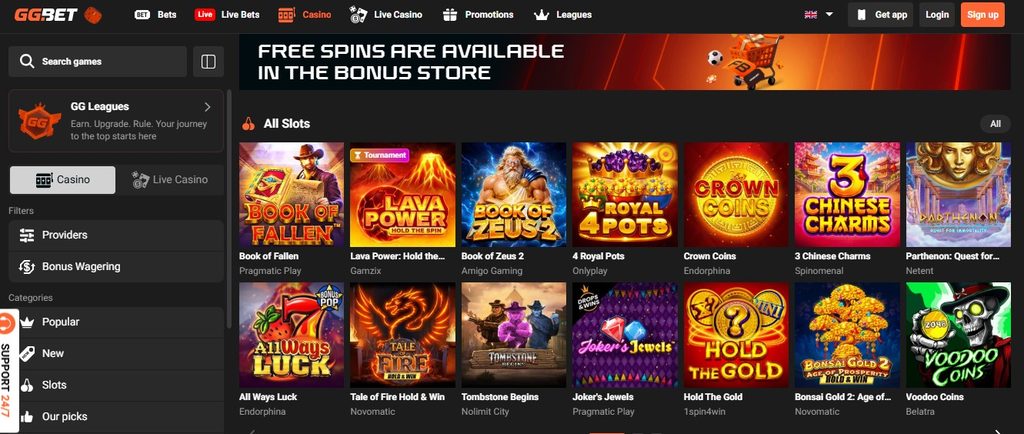
7. GGbet, 30x with no cap on a round
| Item | Detail |
|---|---|
| Maximum stake | None published |
| Spins granted | 50 |
| Spin value | 0.20 Euro, for a 10 Euro package |
| Wagering | 30x |
| Payout ceiling | 10 Euro |
| Assigned title | Sweet Bonanza (Pragmatic Play) |
| Code | None published |
Thirty times the winnings sits between the light requirements above and the 45x pair below. Notable here is the ceiling. Ten Euro ties entry 5 for smallest on the page, and it equals the package worth precisely, so the limit takes hold the instant staking completes. Sweet Bonanza runs tumbling reels with a multiplier feature.
8. Martin Casino, where the requirement reaches 45x
- Reels: Book of Ra Deluxe — Novomatic’s build
- Spins: 100 at 0.10 Euro, 10 Euro in total
- Code: FSBONUS100
- Ceiling: ten multiples of the bonus, reaching 100 Euro
- Wagering: 45x, measured on winnings
- Round cap: unpublished
Nothing on the page allocates beyond a hundred rounds, and entry 9 allocates as many. Framed as a multiple, a ceiling turns into arithmetic worked on the package rather than a sum fixed quite separately, climbing with a bigger credit and dropping with a smaller. Against a 45x requirement the hundred-round allocation is what keeps the turnover per round manageable.

9. Irwin Casino, the same package on other reels
Wherever entry 8 quantifies something, Irwin quantifies it identically: a hundred rounds of 0.10 Euro worth 10 Euro, 45x, a ceiling at ten times the bonus reaching 100 Euro, FSBONUS100 keyed in while registering. The reels alone move. OOF the Goldmine Planet out of BGaming takes these rounds, a cluster grid themed on space mining where entry 8 runs an expanding symbol. Nothing unusual about two brands sharing a code and a rulebook in this market, and since registration rules are enforced account by account these stay separate claims. Nothing linking the sites is published.

10. Spinmills, 50x and no stated ceiling
And where no ceiling is named whatever? There is nothing to report, and that describes this list’s final entry. Fifty free spins go to Le King, out of Hacksaw Gaming, under the page’s steepest requirement at 50x, claimed on SPM50 during registration. The published conditions quantify neither a stake per round nor a payout ceiling.
Does an unstated ceiling count in the offer’s favour? No reading supports that. Absent is absent, and 50x stands as the sole published constraint.

Every figure the ten offers publish
Operators’ own conditions fill each row. A dash means those conditions quantify nothing there, and neither estimate nor borrowed figure has been used to cover the gap.
| Bet limit | Casino | Spins | Spin value | Wagering | Cap | Slot | Code |
|---|---|---|---|---|---|---|---|
| 5 Euro | Jet4Bet | 50 | – | 40x | 100 Euro | Aloha King Elvis | BONUS50 |
| 5 Euro | Boho Casino | 30 | – | 40x | 100 Euro | Fruit Million | FMIL30 |
| 5 Euro | Slots Gallery | 30 | – | 40x | 100 Euro | Wild West Trueways | 30WW |
| – | V.Vegas | 50 | 0.20 Euro | 3x | 25 Euro | Book of Dead | – |
| – | HitNSpin | 55 | 0.10 Euro | 3x | 10 Euro | Big Bass Splash | – |
| – | Slotoro | 50 | 0.20 Euro | 5x | 3x the winnings | Gates of Olympus | – |
| – | GGbet | 50 | 0.20 Euro | 30x | 10 Euro | Sweet Bonanza | – |
| – | Martin Casino | 100 | 0.10 Euro | 45x | 10x the bonus, so 100 Euro | Book of Ra Deluxe | FSBONUS100 |
| – | Irwin Casino | 100 | 0.10 Euro | 45x | 10x the bonus, so 100 Euro | OOF the Goldmine Planet | FSBONUS100 |
| – | Spinmills | 50 | – | 50x | – | Le King | SPM50 |
The governing version of a set of terms
Operators publishing in several languages normally name one version as the authoritative one. That clause sits low in the conditions, often inside a closing paragraph on interpretation, and it states which text prevails where two readings diverge. That is worth locating before a claim rather than after a dispute, because it decides which document an argument will eventually turn on.
Divergence between versions is usually a matter of phrasing rather than substance. A clause rendered loosely in one language can read as permission where the other reads as restriction, and the shorter rendering is not necessarily the lenient one. What should not diverge at all is anything numeric. Multipliers, spin counts, ceilings, stake caps, promotional codes, the name of an eligible title: all of these are independent of language, and a reader should find them matching in whichever version they open. Failing that, the governing text decides, and the mismatch deserves raising on its own account.
The practical habit follows from that. Open the version you read comfortably, then compare the figures against the governing one. Numbers can be checked without fluency, which is the point: reading a clause requires the language, while reading a figure does not.
Two refinements make the check quicker. Work from the table of figures rather than the prose wherever an operator provides one, since a table isolates exactly the values that ought to be identical and strips away the phrasing that legitimately varies. And note which clauses are allowed to differ before starting, so that a genuine divergence stands out: territory lists, payment routes and support hours are maintained per market and will not match, while multipliers, ceilings, caps, codes and titles have no reason to move at all.
One caution about staleness. Conditions get revised, and translated versions are rarely revised at the same moment as the original. A figure that differs between two versions may therefore reflect a change caught in one document and not yet in the other, rather than an error in either. That possibility does not alter which text governs, but it does change what a reader should ask: not simply which figure is correct, but which version carries the current revision.
The product itself, and how it switches on
- Registering earns the credit, with no payment going in first. That alone distinguishes the format from matched welcome credit, whose size follows whatever arrives.
- A bonus balance is what lands, ledgered away from cash. Stakeable. Not withdrawable. The conditions set out the one way across.
- To an operator it is recruitment spend. Multiplier and ceiling keep that spend predictable per account.
- Four offers above need nothing typed; an accepted registration suffices.
- Six want a code, due on the registration form at the moment of creation.
- A third route runs elsewhere in the market: credit arrives inert, waiting to be released from the promotions area. No entry here uses it.
- Conditions bind the moment credit appears. Multiplier, ceiling, named title, stake cap where there is one, the span allowed. None waits on a first round being played.
Working out the turnover requirement
- Counter first. An account area shows the figure staked beside the figure required, and that pairing governs. Pencil arithmetic only forecasts it.
- Know why it crawls. Reels usually post a whole stake. Tables and dealer rounds post part of one, or none. Stray from the named title and a draining balance can sit beside a motionless counter.
- Settle what the multiplier acts on: winnings from the spins, across all ten. Aim it at the credit’s nominal figure and the answer is off tenfold or worse.
- Multiply. For demonstration: 26 Euro won under 24x needs 624 Euro staked. The same 24x against a 49 Euro bonus needs 1,176 Euro. One multiplier, 552 Euro between the answers.
- Steep end. Entry 9 asks 45x, so 47 Euro of winnings becomes 2,115 Euro to stake.
- Gentle end. Entry 6 asks 5x. That same 47 Euro becomes 235 Euro, nine times smaller.
- Check for a round cap. Five Euro is the figure across the first three entries, standing until the bonus ends. Exceed it once and the balance tends to follow, no bet being cut back in compensation.
- Keep the span in view, since it covers spins and staking together. Still outstanding at its close, a requirement reads as failed, and whatever progress stood behind it pays out nothing.
One figure never describes the work. Put 3x beside a ceiling of 25 Euro, then 50x beside no published ceiling, and two quite different propositions emerge. The clause below decides which repays pursuing.
The limit on what an offer pays out
Three shapes of ceiling appear across these ten. Five state a flat sum. Entries 8 and 9 derive theirs from the bonus, so it moves as the credit does. Entry 6 pegs its own to the winnings, making it the one that grows behind a strong result. Entry 10 names nothing, a different matter from being uncapped.
Whichever shape applies, the timing is identical. A ceiling bites as a withdrawal goes through processing, never during play, and it bites after staking has settled rather than alongside it. Anything sitting above the figure is deleted on the spot. Numbers from entry 9: 330 Euro won at Irwin reaches payout, leaves as 100 Euro, and 230 Euro proves unpayable on the published conditions.
| Casino | Maximum release |
|---|---|
| GGbet | 10 Euro |
| Jet4Bet | 100 Euro |
| Irwin Casino | 100 Euro |
Those three bracket a range of ten to one. Nothing else here travels so far. Read the ceiling ahead of allocation size, then confirm the match across versions, a ceiling being a number and not a phrase.
Variants of this credit
| Variant | What reaches the account |
|---|---|
| Spins on one assigned title | A fixed count at a fixed stake, bound to a single game |
| Free credit rather than spins | A small bonus balance spendable across part of the catalogue |
| Spins with no turnover condition | A fixed count whose proceeds carry no multiplier |
| Instalment release | One allocation divided and credited on separate occasions |
| Credit for registered accounts | Issued to an existing player instead of at sign-up |
| Formats confused with this one | Cashback, referral credit, deposit-matched codes |
All ten entries above belong in that first row, where the bulk of this market sits. The others each trade something away. Free credit purchases latitude about where it goes, and advertises for less. Take the multiplier away, as an allocation free of turnover does, and in exchange there usually appears a lower ceiling or a curtailed span. Instalment release hands one allocation over in parcels, every parcel carrying its own terms, so finishing one forecasts nothing for its successor. Accounts already registered meet the same mechanism, redirected toward retention.
That bottom row earns its place for a particular reason here. Cashback, referral credit and deposit-matched codes get described in language close enough to this product that a translated page can blur the difference further. None of the three is a no deposit bonus: the first returns part of recorded losses, the second wants an introduction made, the third wants payment up front.
What a balance actually releases
Picture an account holding 66 Euro, 29 Euro of that bonus funds. Under cashable terms all 66 Euro comes out. Under sticky terms 37 Euro comes out, the 29 Euro subtracted on exit. A single clause in the conditions settles which.
Cashable has the entire balance converting once a requirement is met, winnings together with credit. Sticky, the non-cashable variety, converts the winnings and withholds the credit, whose purpose as staking fuel ends at that point. Sticky is the tendency on free spin offers, no payment having gone in and therefore no original stake underneath the balance to be handed back.
That clause lives among the conditions, beside both other figures, and never in a headline. And of everything on a conditions page, this is the clause where wording carries the most weight across versions, because the distinction rests on how a sentence is phrased rather than on a figure anyone can compare. Advertise two offers at the same maximum and they cease being equivalent as soon as one subtracts the credit, with no number on the page disclosing which.
Credit issued without a turnover requirement
Spins carrying no multiplier do get granted by some operators, which makes whatever the rounds return payable as soon as a balance settles. Uncommon, though real. No entry here qualifies; 3x, carried at entries 4 and 5, is a requirement like any other. Should a genuine example turn up, the restriction has usually relocated rather than gone: a thinner allocation, a harder ceiling, a sole permitted title, or a shorter window to spend in. Locate the maximum release first regardless. Zero staking under a harsh ceiling may return less than light staking under a liberal one.
Working through a claim
- Read the territory list published with the offer before registering. Claiming turns on that list, not on a page rendering.
- Open the conditions in the version you read comfortably, then check the figures against the governing version.
- Sign up with details corresponding to the account holder’s own documents. Divergence clears registration and emerges at a first withdrawal.
- Supply any published code during registration itself. Entry 1 uses BONUS50, entry 3 uses 30WW, and entries 8 and 9 both use FSBONUS100. Entries 2 and 10 publish codes too, while entries 4, 5, 6 and 7 need nothing typed.
- Find the confirmation message and use the link inside. Unconfirmed addresses receive no credit.
- Switch the offer on under promotions where an account requires that, then weigh the credited total against the advertised one before anything opens.
- Launch the assigned title within the account, not by hunting through a search box.
- Watch the counter as rounds go on, and track how much span is left.
Claims fail at step four more than anywhere else, a code presented once registration has closed being rarely honoured afterwards.
Funding routes and payout routes
| Route | Typical use |
|---|---|
| Local bank transfer services | Specific to individual markets and usually best supported inside them |
| Debit and credit cards | Dependable inbound, less consistent outbound |
| Electronic wallets | Skrill, Neteller and comparable services, generally quickest outbound |
| Cryptocurrency | Carried by a portion of these brands, with the volatility that implies |
| Prepaid vouchers | Paysafecard, Neosurf and similar products, inbound only |
Half that table is irrelevant to begin with. No offer above needs funding, which is the whole definition. The other half becomes relevant at the end, and rather suddenly.
Arrive at a withdrawal with no payment history on the account and no inbound path exists for money to travel back along. Operators largely send funds back by whichever route delivered them. Absent such a route, one gets picked and verified with a request already under way, which depositors never face and therefore never anticipate.
Two rows carry their own warnings. Vouchers run inbound only and will take no payout, which means naming one achieves nothing. Wallet-funded deposits, meanwhile, count as promotion-ineligible at plenty of operators, touching nothing here while possibly closing off the offer after this one.
This is also the part of a site likeliest to differ between versions, and legitimately so: routes genuinely vary by market, where bonus conditions do not. A difference in the payment list is ordinary. A difference in a wagering figure is not.
Identity gets confirmed at every brand above before a first withdrawal is released, which is a standing condition rather than an exception.
Which parts of a site get translated
- Promotional pages and bonus conditions are translated as a matter of course, since they are what brings a registration in.
- Game titles are not. A slot keeps its original name everywhere, which is useful: the eligible title in one version will read identically in the other.
- Promotional codes are never translated either. A code is a string, and a version offering a different one is a discrepancy rather than a localisation.
- Payment pages are often partly translated, with route names left as they are because those names are brand names.
- Help articles and policy documents trail behind. It is common to find current conditions in one language and an older revision in another.
- Support hours and channels are frequently stated only in the primary version, which matters because a clause that needs clarifying has to be discussed with somebody.
That last point is the one to weigh before claiming. Reading a clause is one task. Disputing one is another, and disputing needs a channel running in whichever language the reader can be precise in.
Reading terms on a handset
Devices change no condition, and all ten offers open in a phone browser without an install. Length changes. What fills one desktop column runs to many phone screens, and the clause naming the governing version waits at the very bottom, past the entire document. Readers who stop scrolling early tend to stop before reaching it.
Two narrower problems follow. Sign-up forms tend to bury a code box behind a tap-to-open link, which is the usual reason a necessary code never gets entered at its one opportunity. Counters, meanwhile, retreat under an account menu and stop being visible, making progress something to look up rather than notice.
Two ends of the volatility range
Allocation size and reel behaviour interact, and two assigned titles here sit at the extremes of the second.
| Lower volatility | Detail |
|---|---|
| Title | Fruit Million |
| Studio | BGaming |
| Appears at | Entry 2 |
| Behaviour | Returns at short intervals, modest in size |
Small returns, arriving often. A balance stays in circulation across more rounds that way, which is what entry 2 needs: thirty rounds against 40x is a thin allocation, and surviving rounds matter more there than any single large result.
| Higher volatility | Detail |
|---|---|
| Title | Le King |
| Studio | Hacksaw Gaming |
| Appears at | Entry 10 |
| Behaviour | Long flat stretches, occasional heavy returns |
Here the distribution reverses, as it tends to at a studio working the volatile end: stretches yielding nothing, interrupted by something substantial. Entry 10 pairs that with the page’s steepest requirement, 50x, and the pairing cuts two ways. Land a heavy return early and the multiplier has a balance to chew through.
Run flat instead and the requirement finds no balance to fasten onto. Neither title carries a return-to-player percentage here. Each game reports its own figure in an information screen, covering whatever configuration is loaded at the time.
The houses behind the assigned reels
- BGaming: four assigned titles, ahead of every other house here. A catalogue in the several hundreds and distribution that is very wide explain most of it.
- Pragmatic Play: two. Its output runs to reel formats, dealer tables and further verticals, stocked extremely widely.
- Reel Kingdom: one, from the fishing titles behind its reputation, travelling to operators along the channel Pragmatic Play uses.
- Novomatic: one. Land-based cabinets built the house’s reputation, and a number of its signature reel formats crossed to online release out of that catalogue.
- Two further titles originate outside this group, so these four cover the bulk of what is tabled without covering all of it.
Worth noting for anyone comparing versions: neither a studio name nor a game title gets translated. Both are proper names, so they read identically wherever the conditions are published, which makes the eligible title the easiest clause of all to check across two documents.
Four figures per offer
Four columns, readable at a glance. Dashes mark the unpublished.
| Casino | Wagering | Cap | Code |
|---|---|---|---|
| Jet4Bet | 40x | 100 Euro | BONUS50 |
| Boho Casino | 40x | 100 Euro | FMIL30 |
| Slots Gallery | 40x | 100 Euro | 30WW |
| V.Vegas | 3x | 25 Euro | – |
| HitNSpin | 3x | 10 Euro | – |
| Slotoro | 5x | 3x the winnings | – |
| GGbet | 30x | 10 Euro | – |
| Martin Casino | 45x | 10x the bonus, so 100 Euro | FSBONUS100 |
| Irwin Casino | 45x | 10x the bonus, so 100 Euro | FSBONUS100 |
| Spinmills | 50x | – | SPM50 |
Why these ten appear
- Legible conditions at every operator: multiplier, assigned title, ceiling clause, each spelled out rather than left for inference.
- Wagering covers its working range here, 3x up to 50x, making the multiplier’s effect visible rather than merely described.
- Both halves of the stake question are represented: three offers publish a cap on round size, seven publish none.
- Every way of writing a ceiling appears, plus one offer publishing none whatever.
- Coded and automatic offers both feature, six carrying a code and four requiring nothing typed.
- Figures came off the operators’ conditions at the time of writing, and omissions there stayed omissions here.
Deciding between the ten
- The payout limit, taken before anything else. Whatever the exercise yields sits beneath it, and these ten range across a factor of ten.
- The multiplier, restated in currency. Forty-seven Euro under 45x comes to 2,115 Euro staked; under 5x, to 235 Euro.
- Any cap on an individual round. Three offers impose one, and overshooting forfeits the balance whatever has accumulated.
- Spins times stake, where a stake is quoted, for nominal worth. Four offers quote none.
- The time granted for spins and for staking alike, binding as tightly as the multiplier.
- The territory list accompanying the offer, where claiming is actually decided.
- The numbers in whichever version you read, checked against the governing text. Query a mismatch before claiming.
- The named title’s information screen, because an even payer and an erratic one meet one requirement quite unalike.
- Cashable or sticky. This decides what clearing the figure actually yields.
What support can clarify
Which questions does a desk answer that a conditions page cannot? Those concerning one account: did an offer credit, did a code attach, where has the counter reached, does the account sit inside the territory list, how far has a withdrawal progressed. Conditions state rules. Only an operator can report events.
This brief’s own question belongs here too. Where a clause reads differently in two versions, put it in writing: quote the clause as it stands in the version you read, ask which text governs, and ask for the figure to be confirmed outright. A reply naming the governing version and restating the number both settles the point and leaves a record of it.
Does the channel language count for anything? Considerably. Conditions get translated far more readily than desks get staffed, and somebody able to follow a clause but not to argue about it precisely is disadvantaged exactly when precision is what the situation needs.
How licensing works, and what follows from it
Licensing follows a familiar sequence. A platform and its games go to an authority for assessment, and a licence brings standing duties with it over advertising, approval of games, custody of player money, and the handling of complaints. Rigour differs sharply from one authority to the next, both at the application stage and in whatever supervision comes later. Some authorities license for a single market; others cover operators trading across dozens, Malta’s Gaming Authority and the Gambling Supervision Commission on the Isle of Man being two instances, with Curaçao a third.
Four things fall out of that for a reader holding two versions of one conditions page.
Licence particulars should be word-for-word identical. The number is a number. The authority has a proper name. A footer crediting different authorities in different languages is not localisation and is worth querying.
Age requirements cannot be. Each jurisdiction fixes its own threshold, and the one binding any individual reader is whichever governs where that reader lives. An account’s conditions carry the figure that applies to it, and that is why these offers describe a requirement rather than quote a number bound to be wrong somewhere.
Territory lists are maintained per market, so divergence between versions here is expected rather than suspicious. Claiming depends on the list, though, not on a page rendering, so the list belongs with the figures a reader checks.
Tax belongs to nobody but the reader’s own legislature. Treatment ranges from exemption, through taxation as ordinary income, to a distinction drawn between casual and professional play. No clause in any of the offers above touches the question.
Against a deposit-funded offer
- Getting in: free here, where matched credit is scaled against money transferred.
- Size: 10 Euro is the ceiling on nominal worth among offers quoting a stake. Matched credit tracks a deposit upward with no comparable limit.
- Multiplier: 50x tops this page, which is heavier than a fair number of matched offers rather than lighter.
- Payout limit: normal here, uncommon there, since a deposit never stops being the depositor’s.
- Round caps: three offers here. Rarer on matched credit.
- Games: a single named title apiece against a wide catalogue slice.
- Stake: hours in one case, money in the other.
- Versions: both formats publish translated conditions, and the governing-version clause covers whichever a reader opens.
What it offers and what it costs
| In favour | Against |
|---|---|
| Nothing is paid in to begin | A ceiling bounds every possible release |
| A brand can be assessed at no financial cost | Multipliers reach 50x on this list |
| Every condition is published before the claim | Three offers cap each round throughout the bonus |
| Four of the ten need no code at all | A code missed at registration is rarely added later |
| Figures read identically in every language version | Clause wording can differ between versions |
| The assigned title can be examined beforehand | Each offer permits one title only |
| The counter is visible inside the account | Partial progress is never banked |
| Conditions state whether the balance converts whole | One offer publishes no ceiling at all |
What cancels an offer outright
Three things go wrong before a reel turns.
- Withholding a published code past the close of registration. Retrospective credit is almost unheard of.
- Registration details failing to correspond with the holder’s own documents. Nothing surfaces until a payout is sought.
- Signing up twice at a brand that holds an account already. Credit lost, and both accounts usually closed.
Four go wrong with the bonus running.
- Overshooting a published round cap. Five Euro is the figure at the first three entries, and overshooting generally empties the balance instead of adjusting the bet.
- Reels outside the permitted title. Each offer names a single game, so anything else is misuse.
- Spins still unplayed when the span runs out. They expire, uncompensated.
- Discounted turnover mistaken for full-rate turnover, which exhausts the span against a counter nobody read properly.
Two more go wrong right at the close.
- A span expiring on an unmet figure, which carries off balance and logged progress alike.
- A payout sought with the figure still outstanding, answered at many operators by wiping the credit rather than holding anything in a queue.
Questions about terms and versions
Which version applies when two differ?
Whichever the conditions name as governing, usually in a closing paragraph about interpretation. That clause is worth locating before a claim.
Does a promotional code change with the language?
No. A code is a string rather than a word, so a version offering a different one is a discrepancy to raise, not a translation.
Can a figure be mistranslated?
Numbers do not translate, so a mismatch is an error rather than a rendering. The governing version settles which figure stands.
Where is the governing version stated?
Low in the conditions, inside the interpretation clause, rather than on the promotional page.
Does support answer in every language a site publishes?
Not always. Conditions are translated more often than desks are staffed, and available hours sometimes differ between versions.
Is an eligible title list the same in both versions?
It should be, since game titles are not translated. A difference in the list is worth querying before claiming.
And when a page and its conditions disagree?
The conditions govern over promotional copy, and the governing version governs over any other version of them.
Is a stake cap always published?
No. Three offers above publish one and seven do not, and silence is no guarantee that none applies.
How does a limit expressed as a multiple read?
As arithmetic performed on the bonus instead of a sum fixed independently, so it moves with the credit granted.
Does a package size change by region?
It can, where an operator runs separate promotions per market. What that produces is another offer, not another version of the same one.
Which figure deserves comparing first?
The ceiling, since it bounds the outcome and is a number, which makes it checkable without reading a clause at all.
Limits, pauses and exclusion
Licences oblige operators to carry controls that take hold ahead of play. Grouped by what each governs:
- Money in. A deposit limit, per day, week or month. Reductions apply straight away; increases wait out a delay.
- Money lost. A loss limit, bounding the fall an account can take across a chosen span whatever reaches it.
- Time. Session limits and prompts, intervening at whatever point was fixed beforehand.
- Access, briefly. Cooling-off, which suspends an account and leaves the registration alone.
- Access, at length. Self-exclusion, which more and more regimes now extend from one request to every operator under their licence.
Undoing any of these is simpler than recovering a loss, which makes setting them early the obvious course. Free credit gets considered less carefully than funded play, an argument for identical settings rather than none at all.
On a site published in several languages one further point applies: set these in whichever version reads clearest, because a figure typed into the wrong field is harder to unpick afterwards than one entered deliberately. Whichever services suit the place an account sits in, a licensed operator sets those out on a responsible gambling page of its own. Entertainment is the whole of what these offers are. Earning they are not, and nothing written above hints otherwise.